Pages

Showing posts with label pediatrics. Show all posts

Wednesday, June 29, 2011

Happy Heart Day, William! Five Years!

Five years ago today, we gave our son over to the pediatric heart team with the UF Health Congenital Heart Center so they could fix his heart. Some days it feels like it was just yesterday, other days like it was a lifetime ago.

But one thing that never wavers or changes is our gratitude. Five years later, we are still so grateful to our pediatrician Dr. Dean Dalrymple and local pediatric radiologist Dr. Charles Williams, who finally diagnosed William at age 1, after he'd been so sick for a year. Grateful to Dr. Jay Fricker for taking care of William's heart until Shands hired a pediatric heart surgeon. Deeply grateful to that pediatric heart surgeon -- Dr. Mark Bleiweis -- for choosing Shands and for Shands choosing him. Because of these doctors, William is a happy, healthy, soon-to-be second grader who doesn't have a care in the world.

William, immediately after surgery to
repair his partial anomalous
pulmonary venous return, June 29, 2006.


William with big brother Martin, the day after surgery.
Uncomfortable, but loved listening to his bunny's heart.
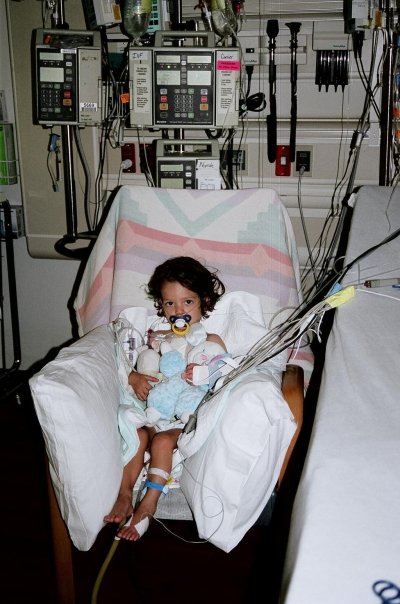
Sitting up in a chair the day after surgery.
Not a happy camper, but when his brother
asked, "Does it hurt?,"
William replied, "No, not much."
Hanging out in bed on Day 2, still feeling sore, still hooked
up to chest tubes that drained blood from his chest cavity.
Back in the chair again on Day 3. This
time he gives his Grandma a smile.
Day 4 and feeling good. Getting ready
to go home! Yes, surgery was on a
Thursday. We were HOME by the next
Monday! That's how William and
Dr. Bleiweis roll.
"Seriously, Dr. Bleiweis. I am SO ready to go home!"
Saying so long to his favorite PICU Nurse Josh Campbell.


Since surgery, we have yearly checkups. We have echos.
We have EKGs.
Sometimes, we have CT scans of our chest
and visit our surgeon so he can see how much |
we've grown and how awesome we're doing
(doctors love to see that with all their patients!)
We even go to Gainesville to walk in the AHA
Heart Walk with our pediatric cardiologist
and pediatric nurse. We love Shands and AHA!
But mostly, we simply revel in every day. Feeling blessed that everything is going so well, and that William is happy and healthy. If you'd like to read more about William's journey, go to www.carepages.com; his CarePage name is MasterWilliam.

Happy 5th Heart Day, William!
We love you so, so much!


Thursday, November 18, 2010

Shadowing My Son's Heart Surgeon

That Friday in the fall, for sure, goes down as one of my most amazing days ever.

I shadowed a doctor who is arguably the best pediatric heart surgeon in the southeast United States, and one of the best in the country. Dr. Mark Bleiweis is the director and principal cardiothoracic surgeon for the UF Health Congenital Heart Center in Gainesville.  

When I asked Dr. Bleiweis over the summer if I could follow him around at work some time, I assumed I would observe him making rounds in the intensive care unit at the UF Health Shands Children’s Hospital in Gainesville. I figured I would sit in on conferences and consultations he had with families whose children were having, would be having, or just had open-heart surgery to repair their congenital heart defects. I guessed that I would sit and watch while he handled administrative work. I was right. I did all those things.

I did not think I would step into his operating room. But I did.

I stood in the very operating room my son had been in four years earlier, about to observe the very surgeon who repaired my child’s heart. At first, it was overwhelming.

For at least an hour, I stood there, kind of numb, thinking: I’m here. I’m in the operating room. I am about to observe open-heart surgery on a baby. I am about to see what my son went through when he was 2 years old, after he left my arms that morning on Thursday, June 29, 2006. 

I took deep breaths and stayed focused on being a writer, taking in as much as I could. I focused on being an advocate, learning more about what happens after we heart parents give our children over to the doctors and nurses who promise to take care of them, repair their hearts, and return them to us whole. I focused on not fainting from the sheer awesomeness of it all.


For more than six hours, I sat, stood, paced, stretched, watched, listened and absorbed everything going on around me while Dr. Bleiweis repaired the swollen, failing heart of a baby.

Born with a complex, life-threatening heart defect called complete atrioventricular canal defect, the baby did not have the typical four chambers and four valves that of a normal heart. She had one large chamber and one valve. 

The baby’s heart defect was so obvious that during the pre-surgery ultrasound of her heart, even my untrained eye could see there were essential chambers and valves missing.

This infant’s heart was working so hard to do its job pumping blood, it was more than twice the size it should have been. Without this surgery, the baby would die.    

I saw Dr. Bleiweis delicately cut away the heart’s protective sac and expose the child’s beating heart. He placed the sac in a solution that makes the flimsy tissue firm and durable; it’s what he would use to make patches to cover the holes in the heart.

The team attached tubes and clamps that led from the baby to the heart-lung bypass machine, which circulates a patient’s blood while the heart is stopped. 

The perfusionist (the person who controls the bypass machine) administered a special mix of drugs called cardioplegic solution to make the baby’s heart slowly stop beating. The perfusionist drained the heart of its blood, and the heart shrank. Throughout the operation, Dr. Bleiweis would ask the perfusionist to fill and drain the heart. It was astounding.

I took turns with medical and nursing students and the anesthesiologist to stand on a stool at the head of the operating table. I gazed over surgical drapes and looked straight down, less than a foot away, into the infant’s open chest as Dr. Bleiweis – using high-magnification lenses – delicately sewed the tiniest stitches into the baby’s imperfect heart.

On this day, Dr. Bleiweis was clearly the leader in the operating room. His requests, directives and commands were clear, direct, exact and instructive. His team might not have always liked what they heard, particularly if he was correcting them, but his criticism was constructive and designed to make his team that much better during the very next operation and every operation after that.

During the four-plus-hour operation, Dr. Bleiweis meticulously patched the holes between the baby’s upper chambers (the atria) and the lower chambers (the ventricles), forming a wall between left-side and right-side chambers. He created two functioning valves – a tricuspid valve and a mitral valve.

His work was so exacting, so intricate and so complete that as I watched the post-surgery ultrasound of the heart, I could clearly see the wall in the center of the heart and the two valves that Dr. Bleiweis created for the baby. The baby’s heart would never be normal, but now it would work as efficiently as it ever could. It was extraordinary.

The science and precision weren’t the only remarkable, memorable aspects of watching this elite team of surgeon, nurses, anesthesiologists and perfusionists.


Dr. Bleiweis, who can operate on the grape-size heart of a newborn baby who’s no bigger than a water bottle, could easily be arrogant or condescending. And yet, he is consistently professional and gracious – to his team, his staff and, especially, to his heart families. I’m still absorbing everything I saw that day, but here are thoughts that have stuck with me:
  • I am amazed and struck that a pediatric heart surgeon must map out – sometimes in a matter of days and other times in a matter of minutes – the best surgical option for a child whose heart is complicatedly misconstructed.
  • There is no room for mediocrity in pediatric heart care – not in preoperative procedures, during an operation, or in postoperative care. Pediatric heart teams persistently reach for excellence. Every single day.  
  • In the operating room, everyone must work cohesively. They must anticipate what the person next to them will need next, do next, ask for next. They must foresee what their patient will do next, will need next. And they must be there, ready. If there are personality conflicts, hard feelings, or bad attitudes, they’re not perceptible. Everyone in the room works harmoniously, willingly, gladly and always with one goal in mind – the care and comfort of the patient.  
  • Dr. Bleiweis and his team sweat not just the small stuff, but the minutiae, every hour of every day. And I – along with hundreds of other heart families each year – am very grateful that they do.  
  • I’m inspired that parents can and do entrust their child’s life to the hands of a surgeon – most often, a person they’ve met only briefly – who promises to repair their child’s misassembled heart. I am even more moved that there are people willing to accept that mammoth responsibility as humbly as Dr. Bleiweis and his team do.  
  • I am utterly, wholly and completely awed that this is what this team does: they fix babies’ hearts. They save babies’ lives. Every. day.

          Thursday, April 8, 2010

          Medical-Specialty Board Certification: It Matters

          “Any doctor can deliver a baby, treat cancer, or declare himself a cardiologist. Certification means the doctor had special training in that field and passed an exam to prove knowledge of it.”

          Six years ago, I would have said Associated Press writer Marilynn Marchione was exaggerating in her recent article, Doctors face board specialty 'expiration dates'.

          Had my son never landed in the hands of a physician who “declared” himself a specialist, I might still think that way. But he did. So I don’t.

          In a previous post about my son William’s heart murmur, I mentioned “the eight-month-long road to a correct diagnosis was ill-paved and rife with potholes.”

          I’d like to explain now.

          At William’s four-month well-baby checkup, his exam revealed The Heart Murmur. The pediatrician (whom we no longer see) referred my son to a specialist -– “a pediatric cardiologist,” the pediatrician said -– to evaluate the murmur.

          If only I’d known then, what I know now: verify credentials yourself. You can’t rely on referring physicians. They might not have verified credentials. They might be assuming a specialist is certified. Or, the specialist might be so rooted in the community that everyone assumes he/she is a board-certified specialist.

          You also can’t rely on advertising -- even though (in Florida anyway) claiming you’re board certified in an area you are not board certified in is against the law.

          If I could do it again, my first stop would have been here, so that my second stop could have been with a real pediatric cardiologist. Despite what the pediatrician said, the local physician who sees pediatric heart patients is not this area’s “only option.”

          Knowing what I know now, I'm not at all surprised this physician misdiagnosed my son. Not just once, but twice. This doctor is nothing more than a pediatrician who completed a pediatric cardiology fellowship ... 35 years ago. Since he's not board certified in pediatric cardiology, there's nothing to show he has pursued any continuing medical education (CME) in this area.

          And there have been so many advances in CHD diagnosis, research and treatment over the past three-and-half decades, it hardly seems possible he could have stayed relevant without a lot of CME.

          Physicians I love and trust implicitly have told me William’s congenital heart defect (Scimitar Syndrome) is not an easy one to diagnose -- implying I should cut the doctor some slack.

          But if it's so hard to figure out, I ask them, then please explain how William’s eventual correct diagnosis was made by a mere pediatrician and pediatric radiologist? Neither of them specialize in, or have had concentrated study in pediatric cardiology.

          Really, if not a pediatric cardiologist, then who is imminently qualified to diagnose congenital heart defects -- even those that are difficult to diagnose? If you're going to "declare" yourself a pediatric cardiologist, then you'd better well know what you're doing!

          After William's diagnosis, we requested a referral to the University of Florida Congenital Heart Center -- one of this area's many options. The physicians there are extremely competent, very compassionate and ... board certified.

          About 15 months after William's open-heart surgery, I filed a formal complaint with the Florida Department of Health. The complaint included misdiagnosis of condition and false advertising. However, DOH declared the physician had done nothing wrong. Nothing. Not even falsely advertising himself.

          I also e-mailed the American Board of Pediatrics about the physician’s advertisements. Although the ABP can’t tell me what, if any, action it took, I noticed that about six weeks later, the physician no longer held himself out in advertisements as a board-certified pediatric cardiologist.

          Marchione writes in her article, “The next time you’re at the doctor’s office, take a peek at those certificates hanging on the wall. Like gallons of milk, some of them are expiring.”

          Better yet, make sure from the start they even have certificates.

          The American Board of Pediatrics sponsors a campaign called “Certification Matters.”

          And let me tell you: It. So. Does.

          Pages